Advertising campaigns are undoubtedly a powerful tool in marketing strategies, but of course some campaigns are more effective than others. It all depends, among other things, on the message and the technology used to carry them out.
If the aim is to make an impact on the viewer in order to grab their attention and convey the brand message, an advertising campaign that uses innovative technologies based on interactivity or new media is more likely to be well received by the public and be even more memorable.
This has a very positive impact on the top of mind of the viewer and/or buyer. There are many campaigns and commercials of this type that have marked a turning point in commercials and advertising over the years, and today we want to show you some of them.
The most impactful advertising campaigns:
-
Nike (Daito Manabe, Rhyzomatics)
Although launched in 2010, this Nike campaign still provokes feelings of surprise, skepticism, and amazement in viewers. With the release of their then-new NIKE FREE RUN + shoe, they decided that the best way to present it to the world was as the perfect running shoe. Thanks to this unusual campaign, they linked their product to music, which is essential for many runners when they exercise. The result was a shoe that was transformed into a musical instrument with which HIFANA, the Japanese breakbeat and hip hop DJ duo, performed a piece of music.
Behind this advertising piece is Rhizomatiks Design, the Japanese design studio specializing inmedia art. The shoe prototype was created by Tomoaki Yanagisawa and Daito Manabe, who were responsible for the software development and design. Each shoe was programmed with a different sound, and thanks to sensors built into the soles, that sound could be activated and modulated by twisting or bending the shoe.
2. Toyota IQ font (Zach Lieberman)
Who would have thought that a car would be a great tool for creating fonts? Toyota came up with this concept to showcase the agility of the Toyota IQ. The brand—together with the Happiness Brussels agency, typeface designers Pierre and Damien, graphic design studio PleaseLetMeDesign, software developer and digital artist Zach Liberman, and race car driver Stef van Campenhoudt—created a new typeface, the Toyota IQ Font, by experimenting with computer vision techniques.
It was traced from a series of car movements—which were recorded using a camera mounted on the roof of the hangar where the piece was filmed—and software created specifically for this purpose. The car's movements were directed by the type designers. In this way, the car itself traced the lines that formed the various characters. These movements were recorded and then processed to transform them into Toyota's typeface.
This project, in addition to winning a Grand Prix at the 57th Cannes Lions International Advertising Festival and astonishing an audience that never thought it was possible to "write" with a car, demonstrated in an original and surprising way how agile the advertised product was. A perfect marriage of design, technology, and advertising.
3. Sony RealTime (Memo Atken)
Three viral videos were created for Sony RealTime's campaign advertising Sony'sstreaming service. 3D technology played a key role in these videos, as each one was recorded in a single take, in real time and without post-production.
4.Vodafone Samsung Galaxy Tab
Not all campaigns are based on acommercialand can only be seen on television. Among the strategies available to advertising creatives isvideo mappingtechnology. Thistechnology allows digital images to be projected onto real surfaces. These images are usually animated and interact with the surface onto which they are projected. This was the case with Vodafone and the advertising campaign that took place in Madrid's Plaza de España to launch the Samsung Galaxy Tab.
Vodafone organized Spain's first interactive projectionmappingevent in 2010. Passersby were able to enjoy a unique experience playing and interacting with thevideo mappingprojected onto the structure of one of Madrid's most iconic buildings in Plaza de España. With a Samsung Galaxy Tab in their hands, they controlled the projections onto the surface of the building. In addition, amappingset in the galaxy was projected, allowing attendees to enjoy a spectacular event.
5. New Balance
Another example of projectionmapping isthis audiovisual piece by New Balance. In this case, instead of a building, the projection was made on sneakers. Thanks to this technology, the sneakers changed their appearance in a very dynamic way, offering different designs to the rhythm of the music. It was a fun way to convey the multitude of possibilities offered by the brand in its footwear. This project, created by Hayoung Jung—from Overlay Creative Wrap—for New Balance Korea, was titledNew Balance 1300 Projection Mapping.
6. Samsung Portugal – Face mapping
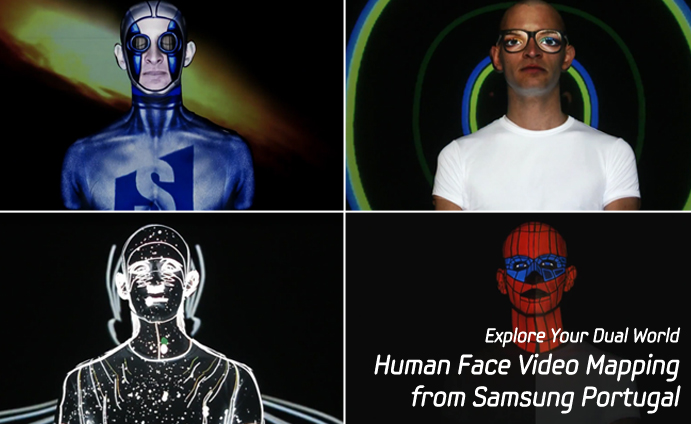
And what happens whenmapping isdone on a human being? This is what Samsung Portugal wanted to explore with the launch of its first dual-SIMsmartphone, the Galaxy Y Duos. The result was both amazing and disturbing: a projection mapped onto a person's face. This video makes full use of projectionmappingtechnology to construct various characters on a human face. The images were projected directly onto an actor serving as a screen. This videomapping technique, normally seen in spectacular projections on buildings and cars, uses the human face as its sole object of work in this video.
7. Full VR Audi Q7 Presentation
Virtual reality could not be left out of this compilation. An example that highlights the importance of this technology for the world of advertising is the presentation of the Audi Q7 in 2016. This presentation was dubbed #imagineQ7 and aimed to transport viewers to an alternative Audi design world that would show them the infinite possibilities of imagination and future technology.
The virtual reality experience had always been designed to be experienced individually. InteractiveLab, in collaboration with Departament Event Marketing and Sila Sveta, contradicted this assertion by bringing a large audience to the launch of Audi's new product. 100 users simultaneously enjoyed a virtual experience that used no lights, screens, or projectors, only sound and hundreds of Samsung Gear VR headsets.
The InteractiveLab team designed and developed a way to control 100 virtual reality headsets at the same time. They also designed a system capable of updating and synchronizing content. In addition, to ensure that the show ran as planned, they created a control panel that provided live reports on the status of the experience. It gave readings on both the temperature of the devices' batteries and the status of the content and the application.
This virtual experience included a panoramic flight through space and a thrilling journey through a big city at the wheel of the new Audi Q7.
In addition to offering visitors an unforgettable experience, they used virtual reality to demonstrate the technical features of their new product.
During the journey, spectators had the opportunity to inspect the car's cabin in detail and capture the vehicle's speed. The experience culminated with the appearance of the real Audi Q7 model, which materialized as if out of nowhere in the middle of the installation.
8. Philips Living Light sculpture (White Void and Kinetic Lights)
Sculpture does not have to be made with traditional materials. Why not sculpt using technology? The results can be incredibly fascinating, especially if they have an application in advertising. This is the case with the Philips brand, which decided to use a modular system based on lights and movement to create a large three-dimensional sculpture that seemed to have a life of its own. The project was calledLivingSculpture 3D modular system, andit was one of the contributions made toPhilips' LivingSculptureproduct family.
WHITEvoid designed a modularplug-and-playsystem that allowed for infinite variations in the design and layout of the sculpture installed on the ceiling of the room. The highly flexible system consisted of anonlineconfigurator for creating and ordering individual pieces, a modularplug-and-playhardwaresystem, and an animation application controlled by an iPad.
9. BMW Museum. Kinetic Sculpture (ART+COM, 2008)
A similar kinetic sculpture project was carried out at the BMW Museum in Germany. In this case, 714 metal spheres were suspended from the ceiling by thin steel wires in a six-square-meter space. These were animated using mechanical technology, electronics, and code.
According to Artcom Studios, the theme of this installation was the process of searching for shapes in car design. This was translated into a seven-minute choreographed sequence: at the beginning, the installation is in a chaotic state, implying that no shape or design idea has been found.
Then, the spheres move individually, creating an impression of spatial white noise.
Little by little, the first geometric shapes emerge, loosely related to the contours of the vehicle that appear later. In the following sequence, a succession of shapes intersect with each other, each one displacing the next. The final shape of the vehicle then emerges from this process.
This narrative is repeated, covering the design process of five iconic cars from the company's past and present.
10. Advertising on bus shelters
Digital and interactive advertising is not limited to enclosed spaces or recording sets. The street can be the perfect setting for truly impactful advertising. This is the case with some advertising campaigns that used bus shelters and bus stop canopies to install these interactive ads. One such example is the advertising campaign for Apotek Hjärtat's smoking cessation products. A smoke detector sensitive to tobacco smoke from passersby was installed on the bus shelter containing the advertisement. When it detected smoke, the protagonist of the ad began to cough, to the astonishment of the smoker, who then saw the brand's product collection.
These are all great examples of how advertising is constantly evolving and how technology is playing—and will continue to play—an extremely important role in its future. This is great news for designers and advertising creatives, who now have thousands of doors opening up to worlds of infinite creative possibilities. If you want to be one of the professionals responsible for creating and intervening in these worlds, take a look at the Degree in Visual Design of Digital Content offered by U-tad.