
Social selling is a technique in which we can build relationships, establish trust, and increase our sales through platforms such as LinkedIn. It involves a strategy and approach that involves the effective use of social media platforms to build relationships, foster trust, and generate sales opportunities in an organic and authentic way.
It focuses on proactive and personalized interaction.
Addressing and resolving questions that potential customers may have throughout their purchasing cycle, using social media as a channel to provide value, education, and solutions that meet their needs and desires, is not just about seeking direct sales.
Here, social selling focuses on building a bridge between the salesperson and the potential customer, with the aim of establishing a strong and lasting connection.
Get leads on LinkedIn more easily through social selling
To achieve good brand positioning, it is very useful to use LinkedIn, as it is the main channel for obtaining quality leads in a B2B business. This is because it is the only social network that allows you to achieve:
- Access to an unlimited number of qualified contacts
- Access to people with purchasing decision-making power
- High-quality leads
- Increased number of business meetings
LinkedIn has become a real treasure trove for those looking to expand their business horizons, not only in terms of sales but also in terms of partners, suppliers, and, why not, attracting talent. According to studies, more and more companies and professionals specializing in selling their products online are committed to training their employees with the best LinkedIn training course for companies and sales teams.
LinkedIn, being a purely work-related platform, allows you to connect with a highly specific audience, so you can multiply the number of leads very quickly and easily.
Social Selling is the process of knowing how to use LinkedIn to build relationships with your target audience, so that before you try to sell:
- interact with them
- position yourself as an expert
- and generate greater digital trust that will help you improve your business processes, thereby multiplying your leads on LinkedIn.
As you can see, this is a radical departure from conventional sales strategies, but trust me when I say that it is the key to generating leads and sales on LinkedIn.
What will Social Selling enable you to do?
- Work on personalization as a priority
- Connect with your audience's emotions
- Position yourself as an expert in what you do and offer.
- Build strong, long-term relationships with each potential customer.
- Add value
- Position yourself as a leader in your industry
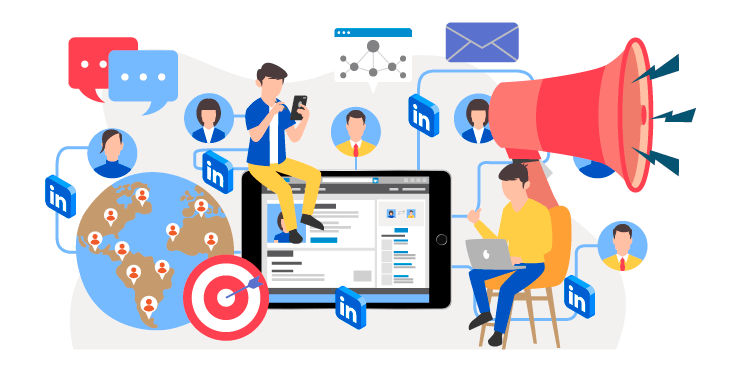
Social Selling
There are seven steps to achieving this, and we describe them here:
1. Create an excellent professional profile to build trust and authority.
Think about this: if you want to get leads on LinkedIn, you need to be trustworthy and demonstrate authority... but how can you achieve this?
Also keep in mind that on LinkedIn, whenever you connect with or invite someone, that person will view your LinkedIn profile and your website to validate who you are and whether it is worthwhile to connect with you.
That's why your LinkedIn professional profile is the place where you should shine. Tell them who you are, what you do, and how you can help them... without selling anything, just try to inform and help.
2.- Use SEO on LinkedIn to increase your visibility
Yes, SEO isn't just for Google. It also exists on LinkedIn, and it's essential. If you manage to rank high in searches relevant to your sector, you'll be on more people's radar.
And perhaps many of them are looking for what you sell.
SEO for LinkedIn allows you to appear prominently in advanced searches, making it a "passive" way to increase your volume of leads on LinkedIn on a monthly basis.
3.- Create content that everyone wants to read
One of the questions I am asked most often is: "What kind of content should I post on LinkedIn?"
Because yes, on LinkedIn you have to publish a lot of content (and good content at that) to become relevant.
To do this, my main advice is to start by identifying the problems or needs of your market, compare them with the benefits of your product or service, and create content that addresses them.
In videos, text, infographics, articles... whatever you think will have the greatest impact on your audience.
And again, without selling anything in your content.
4.- Build meaningful long-term relationships
No, it's not just about selling.
LinkedIn is a place where you can build long-term relationships and expand your network of contacts, generating a high level of trust with them.
How? ... Look for new quality contacts every week, and once they have accepted you, network with them.
Introduce yourself and start a conversation with them. Participate in their content weekly, rate it, and comment on it. Use messaging to establish this relationship, but don't try to sell anything.
If your content provides real value, your own contacts will ask you for help. And if not, over time, you need to know which contacts are more "mature" so you can start a natural sales conversation with them.
5.- Prepare your website to generate trust
LinkedIn is great, but all your contacts are going to go to your profile to see your website. And when they go there, what are they going to see?
If you have a website, you're halfway there. Redirect them there in your content; perhaps you can point them to your blog to attract them to more commercial content or directly to your sales pages in your posts.
Remember, don't sell with your content, provide solutions and add the link to your website. Anyone who is genuinely interested will see what they need without you having to tell them.
6.- Create appropriate resources to add real value
The best way to start a natural conversation that can lead to a business meeting is to keep adding value.
And for that, resources such as eBooks, demos, or webinars are the secret ingredients of your strategy that you must know how to offer at the right time.
I want to leave you my first "natural" sales message with contacts I have been interacting with for some time.
"Hello Pepito, good morning. A couple of weeks ago, I published an eBook on how to multiply your sales volume on LinkedIn, and I think you might be interested. If so, please send me a message and I'll send it to you internally. I don't want to be intrusive and send you something that doesn't interest you. Best regards."
Believe me, it works, and very well.
7.- Close your sales meeting
Don't forget that in a sales process, there's nothing worse than offering something to someone who doesn't need it. It makes you look very bad.
That's why all your interactions must be focused on subtly determining whether your audience really needs what you're selling or not. Or maybe they already have it because your competition has been quicker off the mark.
Only discuss a potential sales meeting with those who you know for sure need it and who will greatly benefit from it. These are the people you will have to put the most effort into, as they are your real target audience.
If you really need it and know how to sell it well, the initial sales meeting is just a formality. Let's go get those customers!
https://vtex.com/es/blog/marketing-es/que-es-el-social-selling
https://anunciart.com/mupis-de-heinz-que-sirven-catsup-gratis-instalados-en-chicago/
https://www.youtube.com/watch?v=jfsESVqTQdk