Although billboards are highly visible and many people can see them, this does not mean that viewers are interested in your products. We have seen several, although we still do not know how to identify and distinguish between billboards. We will describe them below.
Unipolar: this sign is positioned on a pole to provide unbeatable visibility.
Structural: Take advantage of a building's visibility and height to provide a long and impressive view.
Latticework: Latticework consists of reticular structures made of straight bars that are interconnected with knots, forming triangles or rectangles for advertising purposes.
It is important to mention that these three different types include the following characteristics:
- Strong visual impact
- Guaranteed audience
- Competitiveness with large markets or businesses.
This type of advertising is used to send a specific message, such as a public service announcement or product advertisement, among others. And although it is perhaps one of the oldest advertising tools, it still has some advantages and disadvantages that are good to know about.
Billboard advertising is what is commonly referred to as billboards, those found in highly visible areas with a large and constant flow of people.
They can be paths, roads, urban areas, and in general, almost all places in cities.
Of course, as in all aspects, there are different styles and types of billboards. Below, we describe some of them.
What types of billboards are there?
- Eight-panel billboard. Advertising billboard consisting of eight prints on a panel that fit together to form a single message, either with an image, text, or a combination of both.
- Illuminated fence: any type of fence can be illuminated; you just need to install the appropriate lights. Lighting is used to highlight the fence.
- Single-post fence: this fence is unique in that it is supported by a single post for stability, and its main distinguishing feature is that it is usually taller than other types of fences.
- Double-post fence, designed to be supported by two posts and used for fences where advertising occupies a large space.
- Low fences are commonly seen in soccer stadiums, where they are positioned at the height of seated spectators. They can easily be combined with two advertisements at once, and there are even digital versions of these fences.
- Three-sided billboard, billboard created from interlocking panels with advertising printed on three sides. What sets it apart from other billboards is that it is not static; rather, the three sides are combined by means of an automatic rotation mechanism, allowing the three images to be combined.
- Digital fence. This type of fence is fully computerized and configured through coding. It is much more versatile, but its maintenance and cost are also higher.
There are also static billboards. Naturally, a billboard is considered static when the advertisement cannot move, for example when it is located on a billboard, on the wall of a building, or at a bus stop.
It is considered static when the advertisement cannot be moved, for example when it is located on a billboard, on the wall of a building, or at a bus stop.
https://anunciart.com/sin-las-redes-sociales-es-imposible-llegar-a-los-mas-jovenes/
There are seven points that are important for billboards to have the greatest impact:
- Less is more.Be concise; you should be able to communicate your message at a glance. Be clear about what you are going to say and express it in a simple way. Minimalism inoutdoor advertisingis a good source of inspiration.
- Less is more.Don't overload your design. Stick to what you need to say, but don't fill your design with elements that distract attention. If a picture is worth a thousand words, use it. If you need text, use it. Aim for the ideal balance. Anything that doesn't communicate is superfluous.
- Use appropriate colors.Don't use dull colors, but don't use garish colors either. Multicolor is not the solution. Create harmony that highlights your message, play with shades and textures.
- Rely on good typography.Capturing the audience's attention is essential, but conveying your message is key. Use legible fonts and apply them at the size that suits you best. Sometimes, words such as "free," "offer," or "sale" call for a design that simply highlights the body text.
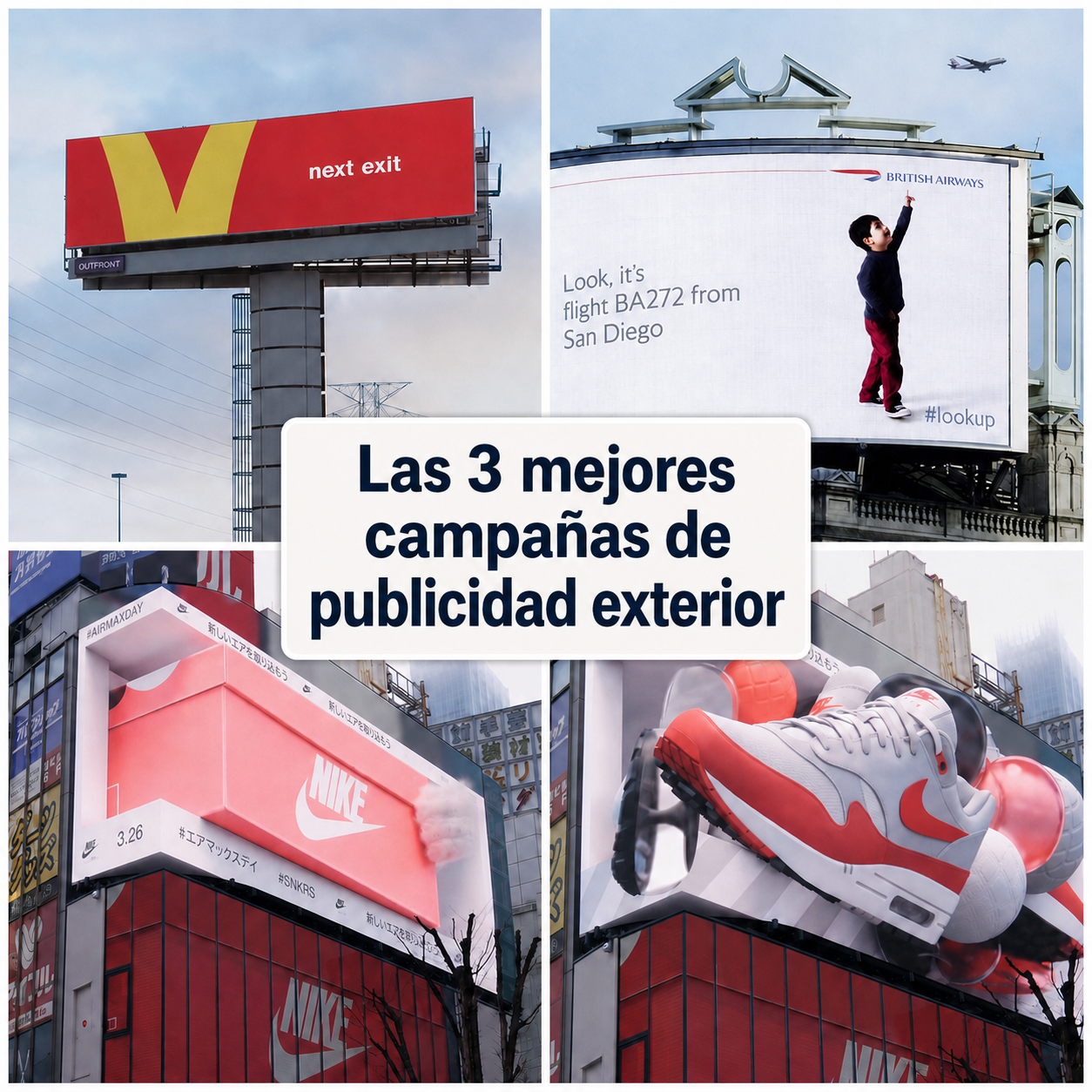
- Take advantage of your surroundings.A billboard in the city is not the same as one found on the highway. Outdoor advertising must increasingly adapt to its surroundings and play with them.
- Focus on one concept.Think of a design that represents one idea. Don't try to communicate more than one message, because this will minimize the impact. Be clear about who you are targeting and seek to engage that target audience. Use elements that work in your favor and don't shoot in the dark. A powerful concept will translate into a powerful design.
- Not everything goes.Yes, it's about getting attention, but not at any price. Don't resort to garish colors that hurt the eyes or inappropriate text or images. Remember that your design speaks about you, your company, and your product. Your design will represent you, and people will associate you with what they see on your billboards.